KEY TAKEAWAYS
- •Susie Cave's new label, Weddings and Funerals, is a 25-dress demi-couture collection split evenly between black and white, operating appointment-only from a single West London store
- •The brand follows The Vampire's Wife, which Cave closed in 2024 after it grew too large for her to maintain personal creative control over fit, finish, and production
- •The funeral concept was inspired by a photograph of Karen Elson leaving a friend's funeral in a black velvet Vampire's Wife dress; Cave has worn a Philip Treacy hat to her own grandfather's funeral as a deliberate act of celebration rather than excess
- •Two brides have already been dressed by the label, with appointments at the West London store booked into October
- •There is no online store; clients book directly through the shop on Kensington Church Walk or via Zoom consultation, with international client options still being developed
Susie Cave has spent her career dressing women for the two occasions everyone struggles to dress for and almost nobody talks about: funerals and weddings. Her previous label, The Vampire's Wife, became an unofficial go-to for both — brides who wanted a non-traditional look, mourners who wanted to honor someone properly, wedding guests who wanted to feel like themselves rather than like wedding guests. When the brand closed in 2024, Cave did not disappear from fashion. She went away and built something that names the thing directly. Her new label is called Weddings and Funerals. It is exactly what it sounds like, and it is also, she is careful to point out, not exclusively that at all.
The 25-dress demi-couture collection splits evenly between black and white — half built for occasions that call for darkness, half for occasions that call for light. None of it is designed as literal bridal or funeral wear in the traditional sense. All of it lends itself naturally to both, which was precisely the pattern Cave noticed repeatedly with The Vampire's Wife: dresses she had designed with no wedding or funeral intention in mind kept ending up at exactly those events, worn by women who wanted something that felt true to themselves rather than dictated by occasion convention.
Cave describes the gap between closing one brand and opening the next as feeling far longer than it actually was. She is relieved, by her own account, to be back — sad to imagine a version of events where she had stayed away. The new label operates on a different scale and a different model than The Vampire's Wife: appointment-only, no online store, intentionally kept small in a way the previous brand, at its peak producing six collections a year and hundreds of units of single styles, never managed to stay.
Why Weddings and Funerals Makes Sense as a Single Brand
The pairing of weddings and funerals under one brand name sounds, on first encounter, like an odd combination. Cave's reasoning makes the logic immediately clear: these are the two occasions that form the apex of most people's personal narratives, the moments that demand to be dressed for correctly and that, for a significant number of people, remain genuinely difficult to dress for. A wedding has an entire industry built around solving the dressing problem. A funeral, despite being equally significant, has almost nothing.
Cave's own account of why people gravitated toward The Vampire's Wife for both occasions, despite the dresses never being designed with either in mind, suggests something specific about what the brand was actually offering: dresses that allowed people to feel like themselves during moments when convention typically asks them to disappear into a role — the bride, the mourner — rather than remain a person with their own taste and presence.
She is careful, throughout her description of the new brand, to resist any reading of the name as morbid or mawkish. The name is lightly comical, she says, and it is entirely up to each individual how they choose to relate to it. That framing matters: Weddings and Funerals is not a brand built around grief or sentimentality as a marketing hook. It is a brand built around an observed gap in how fashion serves two specific, significant life moments, with a name precise enough to signal exactly what it offers without requiring further explanation.
The store itself, tucked into Kensington Church Walk — a quiet, village-like passage of independent shops bookended by St Mary Abbots church — reinforces the brand's intimate positioning. The space feels closer to a private salon or atelier than a conventional retail shop, which is consistent with an appointment-only model built around individual consultation rather than browsing.
Demand has already materialized quickly. Two brides have been dressed in the debut collection, and appointments at the West London store are booked into October — a pace that suggests the same organic, word-of-mouth-driven following that made The Vampire's Wife successful has carried over directly to the new venture, even without an online store to drive discovery.
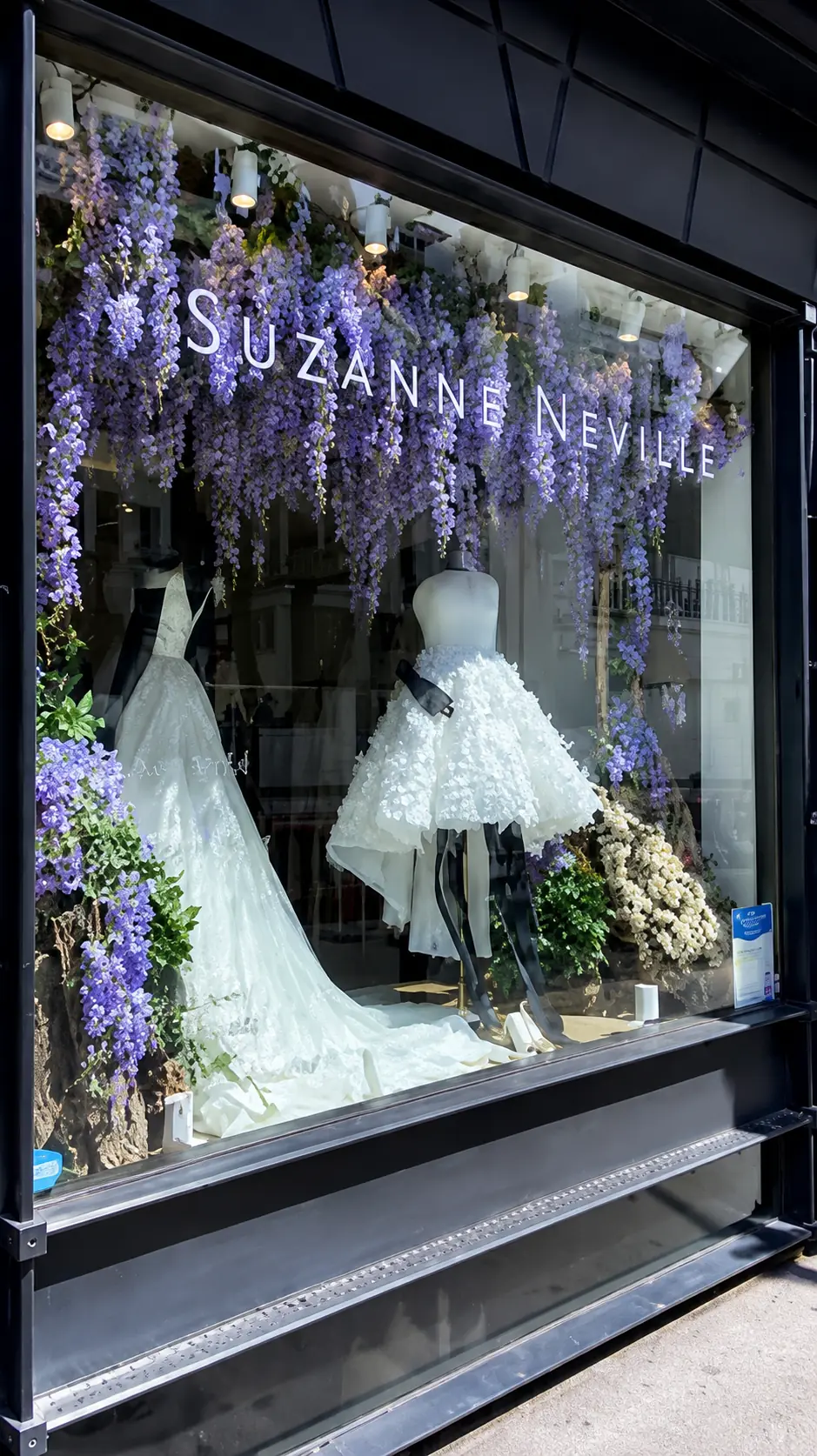
Weddings and Funerals operates from a single appointment-only store on Kensington Church Walk, a quiet passageway of independent shops in West London bookended by St Mary Abbots church.
The Wedding Dresses Nobody Asked Her to Design
“So many people would write to me saying that they got married in The Vampire's Wife. I wondered why people gravitated towards my pieces because they weren't designed as wedding dresses. Perhaps, somehow, there was a subliminal message.”
The wedding half of Cave's new brand grew out of a pattern she observed for years rather than a deliberate decision to enter bridal design. Brides repeatedly wrote to her describing their wedding day in The Vampire's Wife, despite the brand never marketing itself as bridal in any conventional sense. Cave's own theory — that something about the brand's name, or her own 30-year marriage, created a subliminal association — is offered with genuine uncertainty rather than a confident explanation.
What is certain is the outcome: two brides have already been dressed in the new collection's debut season, and bridal-specific appointment demand at the Kensington Church Walk store is significant enough that the calendar runs into October. The dresses are not designed as wedding gowns in any traditional sense — there is no white lace ballgown silhouette dominating the white half of the collection — but the same quality that drew brides to The Vampire's Wife appears to be carrying over directly: a non-traditional option for women who want their wedding day to look like them rather than like a category of dress.
The Craft Behind Every Dress
WHY IT MATTERS
The craft level at Weddings and Funerals exceeds even The Vampire's Wife's already considerable standard, with hand-finishing playing a defining role across the collection. Ornate pearl embroidery is produced by artisans in India, a craft partnership that brings a level of detail work into the collection that would be prohibitively difficult to replicate at scale — which is, by Cave's own design, exactly the point. This collection is not built to scale the way The Vampire's Wife eventually did.
Beyond the dresses themselves, Cave's services extend into her broader professional network: clients gain access to her trusted manicurist, hairdresser, and makeup artist, along with — given her marriage to musician Nick Cave — a more specifically musical network for clients whose occasions call for it. She describes this expanded service offering as a natural extension of decades spent in the fashion industry, where she has accumulated genuine relationships and resources that she now wants to share directly with her clients rather than keep separate from the clothing itself.
Susie Cave's Own History in Fashion
Cave's design sensibility did not emerge from nowhere. She was scouted as a model at 15 by the legendary Bethann Hardison and went on to work with Dior, Versace, and Yves Saint Laurent, photographed across her modeling career by Sarah Moon, Nick Knight, and Guy Bourdin — a list of collaborators that constitutes a genuine education in high fashion craft and image-making, absorbed from the inside rather than studied from a distance.
That history directly informs her current approach: she handles marketing and art direction for all of Weddings and Funerals' shoots personally, ensuring every aspect of the brand's public presentation happens in what she describes as her own quiet way. The continuity between her modeling-era exposure to top-level fashion craft and her current hands-on control over every part of the new brand — design, fit, marketing, client relationships — reflects someone who has spent decades learning exactly what she wants a fashion brand to feel like, and is now in a position to execute that vision without compromise.
Frequently Asked Questions

Claire Whitmore has spent more than a decade tracking the pulse of global fashion, from the ateliers of Paris to the showrooms of New York. She covers emerging designers, heritage houses, and the business forces quietly reshaping what luxury means today.