KEY TAKEAWAYS
- •The Ralph Lauren flag sweater first appeared on the Fall 1989 runway, worn by model Isabelle Townsend, as part of an Americana and American Folk Art collection
- •A new Catwalk series volume on Ralph Lauren — the first American designer featured — compiles over 1,300 photographs tracing the brand from 1972 through 2025
- •Ralph Lauren wore the sweater himself to close his Spring/Summer 2002 show, held 10 days after the September 11 attacks
- •The sweater has been reimagined across multiple runway seasons, including Spring 2018, Fall 2018, and Spring 2025
- •The design has been worn by Gigi Hadid, Jessica Chastain, and generations of Ralph Lauren loyalists across four decades
Somewhere in America this Memorial Day weekend, someone is going to show up wearing a Ralph Lauren flag sweater. This is not a prediction. It is a pattern with a 35-year track record. The hand-knit cotton pullover that debuted on the Fall 1989 runway has appeared at beach houses and football games, closed a show in Lower Manhattan 10 days after September 11, gone viral on TikTok, and landed in the closets of Gigi Hadid and Jessica Chastain without anyone having to explain why. It is, by almost any measure, the most durable single garment in American fashion — and a new book is finally making the full case.
The Ralph Lauren Catwalk volume, released May 7, is the latest entry in the long-running Catwalk book series — and the first to spotlight an American designer. That distinction matters. The series has catalogued the runway archives of European houses for years. Ralph Lauren's inclusion signals something the industry has long been reluctant to say plainly: that American fashion has a history worth documenting with the same rigor applied to Paris and Milan.
The book compiles over 1,300 original photographs covering the brand's runway output from its 1972 women's debut through 2025. For existing Ralph Lauren devotees, it functions as an archive and a reference. For everyone else, it provides context for why a sweater first worn more than three decades ago is still appearing in new iterations every season — and still selling.
The Sweater That Keeps Showing Up
The geography of the Ralph Lauren flag sweater is absurdly consistent. Sag Harbor. Southampton. Santa Monica. Anywhere the July Fourth weekend version of American life plays out against a backdrop of water and expensive real estate, the sweater appears. It has become less a garment than a reliable indicator of a certain kind of American summer.
That kind of cultural saturation does not happen by accident, and it does not happen quickly. The flag sweater has been in continuous circulation since 1989 — through the grunge era, through minimalism, through the maximalist return, through a pandemic, through TikTok. Each of those cultural moments should have made it feel dated. None of them did.
What the new Catwalk book does, among other things, is provide a framework for understanding why. The photographs trace not just the sweater's appearances but the context around them — the runway collections it belongs to, the styling choices made around it, the cultural moments it was present for. Spread across those 1,300 images, the pattern becomes clear: the design survives because it never needed a trend to justify it.
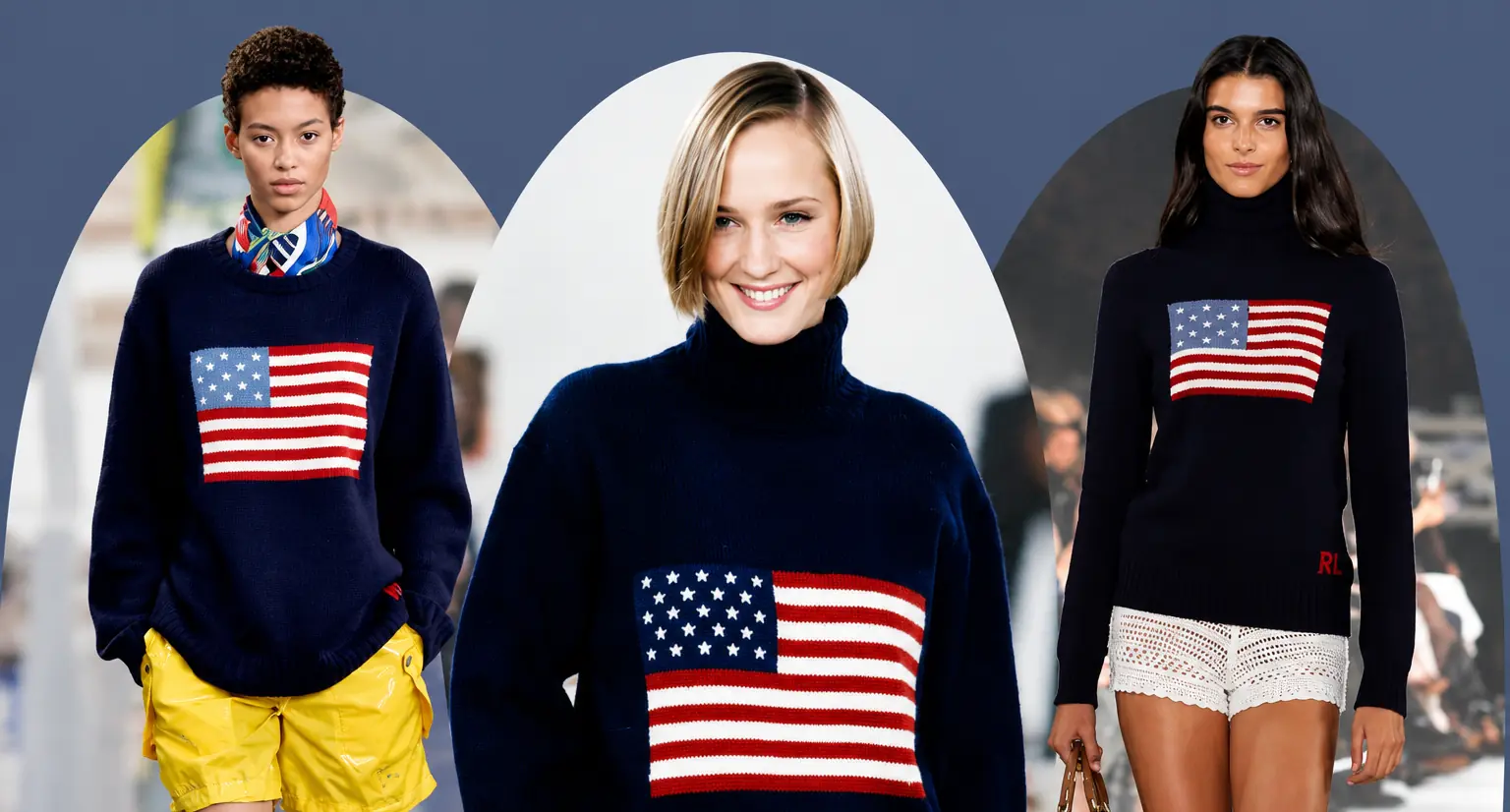
Ralph Lauren has returned to the flag sweater repeatedly, in new materials and constructions, without ever appearing to chase relevance. The Spring 2025 iteration — a turtleneck version paired with bloomer shorts at the Khalily Stables show in Bridgehampton — reads as a confident update rather than a nostalgia play. The structure stays. The details shift. The result keeps working.
The sweater's current cultural position — simultaneously a legacy piece and a social media object — is not a contradiction. It is the logical outcome of something designed with enough clarity that each new generation encounters it on its own terms rather than as someone else's memory.
From Isabelle Townsend in 1989 to the Spring 2025 show at Khalily Stables in Bridgehampton, the flag sweater has maintained a consistent runway presence across four decades.
Where It Started — Fall 1989
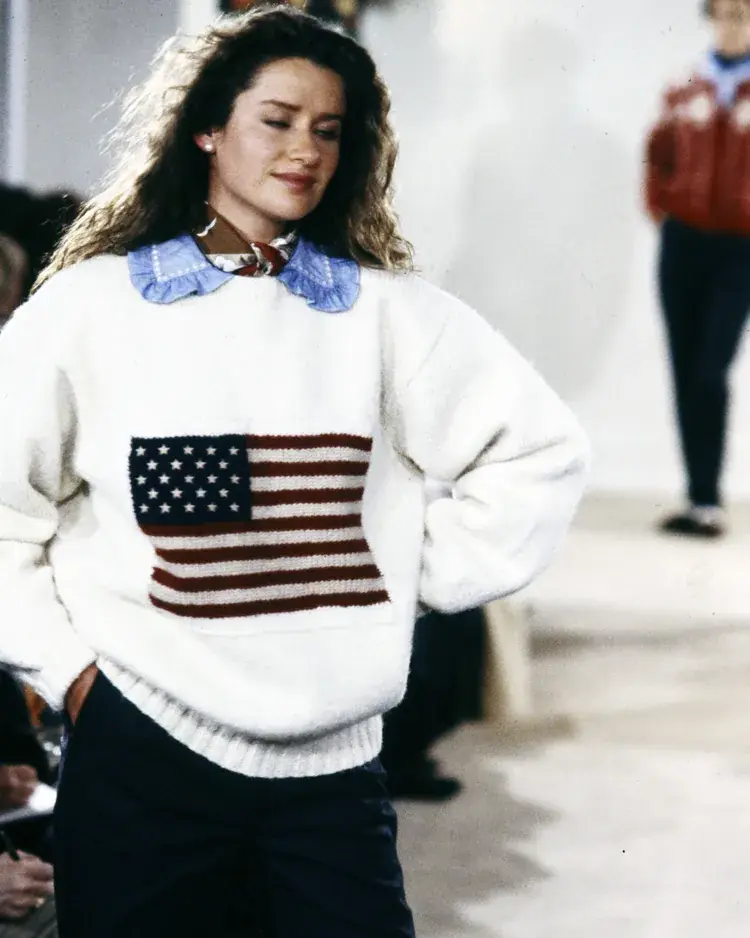
Model Isabelle Townsend wore the original flag sweater on the Fall 1989 runway — the first appearance of a design that has now been in continuous circulation for 35 years.
THE ORIGINAL — FALL 1989 DEBUTThe flag sweater appeared for the first time on the Fall 1989 runway, worn by model Isabelle Townsend as part of a collection built around American folk art and heritage craftsmanship. Ralph Lauren described the collection's inspiration in terms of samplers and patchwork quilts — the handmade objects of early American domestic life. The sweater was hand-knit cotton, designed to carry the one-of-a-kind sensibility of those folk art forms into a wearable garment. It appeared in the Fall 1989 campaign the same season, worn by Lauren himself in front of a log cabin — the kind of image that tells you exactly what the brand is selling and to whom.
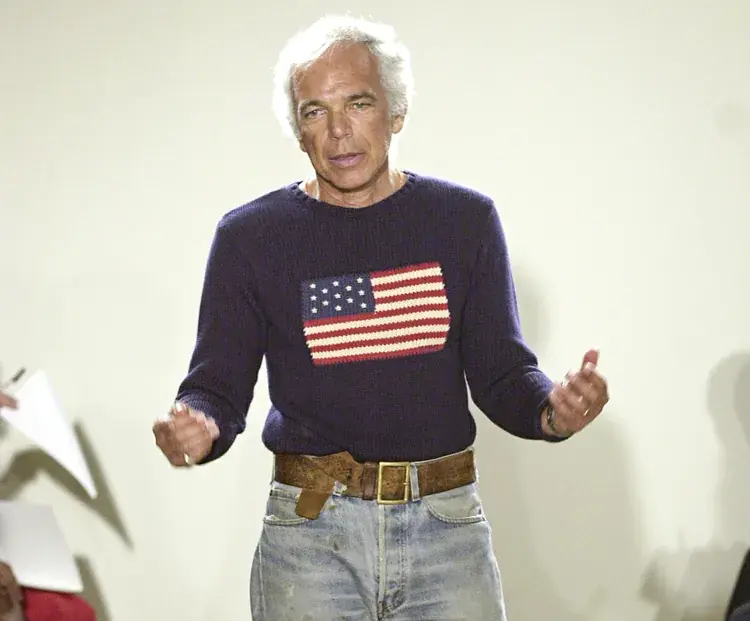
Ralph Lauren wore the flag sweater to close his Spring/Summer 2002 show on 7th Avenue — a show rescheduled and relocated after the September 11 attacks.
THE CULTURAL PEAK — SPRING/SUMMER 2002The sweater's most significant cultural moment came in September 2001. Ralph Lauren wore it himself to close the Spring/Summer 2002 show, held on 7th Avenue just 10 days after the September 11 attacks. The show had been rescheduled and relocated. The collection's Western and pioneer references, planned before the attacks, landed differently in that context — an optimistic vision of American identity at a moment when the city was still in shock. Lauren closing personally in the flag sweater was not subtle. It was not meant to be.
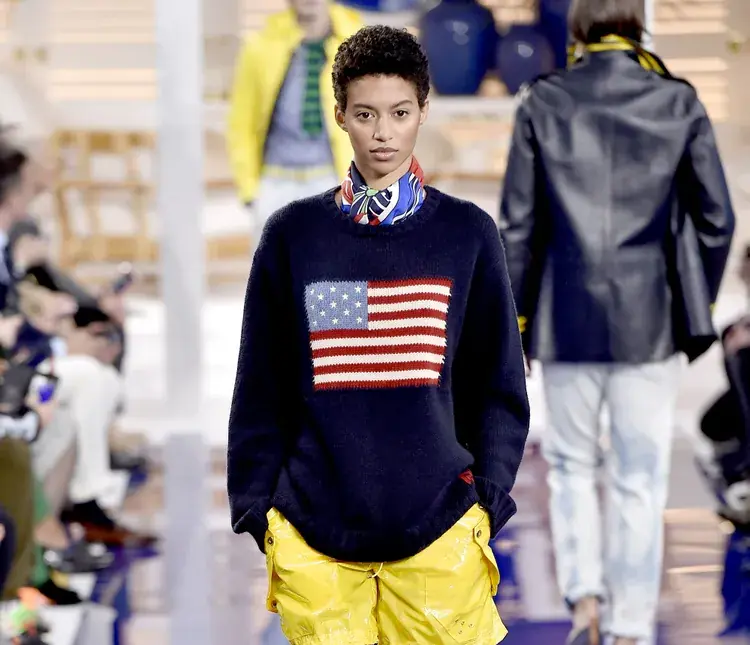
The Spring 2025 iteration of the flag sweater — a turtleneck version with bloomer shorts — shown at Khalily Stables in Bridgehampton.
THE RECENT EVOLUTION — SPRING 2025The Spring 2025 show at Khalily Stables in Bridgehampton produced the most recent runway iteration of the flag sweater: a turtleneck version paired with bloomer shorts. The setting — the Hamptons, where the sweater has been worn by actual people in actual social situations for decades — gave the appearance an added layer of contextual logic. The new construction updated the silhouette without disturbing the design's core iconography. It is the same move the brand has made successfully with this sweater across multiple decades.
The Book That Puts It All Together
“Ralph Lauren is the first American designer to be featured in the Catwalk series — and the flag sweater is the most useful single object for understanding why that recognition matters. The design demonstrates something the series has documented in European houses for years: that a garment conceived with genuine conviction about what it means can outlast every trend cycle that surrounds it.”
The Ralph Lauren Catwalk volume does what a good archive book should do: it makes the argument through images rather than assertions. Over 1,300 photographs covering five decades of runway output, the case for Ralph Lauren's place in fashion history builds without needing to be stated directly. The flag sweater appears across multiple decades of those photographs, each time in a new context, each time recognizable as itself.
The book's broader significance — as the first Catwalk volume devoted to an American designer — reflects a shift in how the industry categorizes design legacy. American fashion has historically been positioned as commercial rather than cultural, pragmatic rather than artistic. The Catwalk series applies the same archival weight to Ralph Lauren that it has applied to European houses. That reframing is overdue, and the flag sweater is the clearest single exhibit in the case.
Who Has Worn It and When
WHY IT MATTERS
The flag sweater's wearer list spans enough range to make it genuinely unusual as a fashion object. It has been worn by the designer himself at one of the most emotionally significant moments in American fashion history. It has been worn by supermodels on runways in New York. It has been worn by celebrities photographed off-duty. It has been worn by people with no connection to the fashion industry at all, in the Hamptons and on beaches from New England to Southern California.
That range is not a marketing accident. It is the natural result of a design that does not require a specific context to make sense. The flag sweater does not look out of place at a formal event or at a Fourth of July barbecue. It does not require a particular body type, a particular age group, or a particular relationship to American identity to work. That kind of universality is what separates an iconic garment from a popular one.
Why It Still Works in 2026
The flag sweater enters 2026 with the same structural advantage it has carried since 1989: it does not need the current moment to validate it. Memorial Day weekend will produce the same sightings it produces every year — at beach houses, at cookouts, at whatever version of the classic American summer is being performed up and down the East Coast. The sweater will be there. It has been there for 35 years.
Frequently Asked Questions

Claire Whitmore has spent more than a decade tracking the pulse of global fashion, from the ateliers of Paris to the showrooms of New York. She covers emerging designers, heritage houses, and the business forces quietly reshaping what luxury means today.